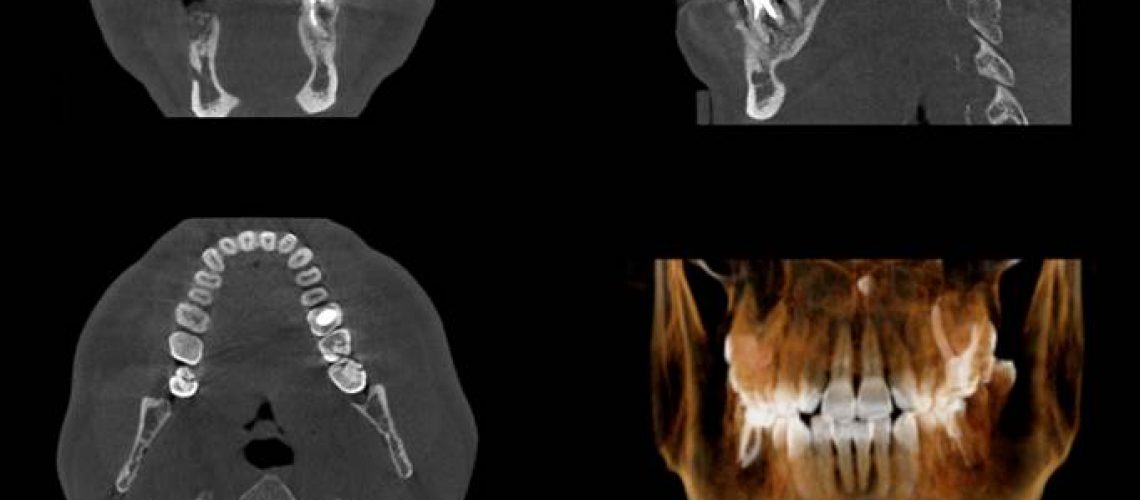
A Cone Beam CT scanner uses a special technology to generate 3D images of dental structures, soft tissues, nerve paths, and bone in the craniofacial region in a single scan. At Oral & Maxillofacial Surgery of Carbondale, CBCT imaging is indicated for deeply impacted teeth, implants, some bone grafting procedures, pathology such as cysts, tori removal, supernumerary teeth, and evaluation of the jaw, sinuses, nerve canals, and nasal cavity.
Ensuring Precision in Oral Surgery: The Critical Role of The CBCT Machine
Images obtained with a CBCT allow for more precise treatment planning and predictable surgical results. We take our own CBCT imaging to ensure accurate data collection. There are many CBCT machines on the market and the imaging and quality you get from one machine to another can vary widely. Different machines have varying field of view (FOV), voxel size, and visualization software. For instance, a Kodak 9000 3D has a max FOV of only 4x5 cm, which would be adequate for an endodontic procedure to visualize 1 or 2 teeth. Many general dentists have a machine with a max FOV of 8x8cm or 8x10 cm, which are all too small for adequate oral surgery. Voxel sizes for CBCT machines vary and some machines have multiple voxel sizes. If the voxel size is larger, the image resolution decreases and that affects the diagnostic quality.
Importance of Selecting Appropriate CBCT Equipment for Oral Surgery
In oral surgery, using a CBCT machine with an adequate field of view (FOV) is critical for comprehensive diagnostics and effective treatment planning. Machines with limited FOV, such as 4x5 cm or even 8x10 cm, may restrict the ability to visualize the complete anatomical context necessary for more complex surgical interventions, such as impacted tooth removal, bone grafting, or implant placement. Therefore, an ideal CBCT machine for oral surgery should possess a larger FOV (e.g., 13x15 cm or greater), allowing for complete visualization of the anatomical regions relevant to surgical procedures, including the maxilla, mandible, temporomandibular joints, and adjacent anatomical structures.
Moreover, selecting a CBCT machine with a smaller voxel size is essential for obtaining high-resolution images that provide greater diagnostic detail. A voxel size of 0.1 mm to 0.2 mm is typically preferred for oral surgical procedures, as it ensures clearer delineation of bone trabeculation, precise localization of anatomical landmarks, and accurate assessment of pathology. Investing in equipment capable of producing high-quality, high-resolution images translates directly into improved surgical outcomes, patient safety, and overall treatment success.
Optimizing CBCT Diagnostic Accuracy
CBCT image quality and accuracy can also be affected if your CBCT is not calibrated regularly. Other factors that affect image quality are artifacts such as when jewelry is not removed prior to taking imaging or metal artifacts due to existing dental implants, crowns, and bridges. We utilize metal artifact reduction technology during reconstruction of the CBCT imaging to improve our surgical planning and prefabrication. Also, patient motion can cause artifacts and result in bad data. If you are seen as a patient at our office and a CBCT is needed, we take our own imaging to ensure we provide the highest level of surgical care and minimize any associated risks.